












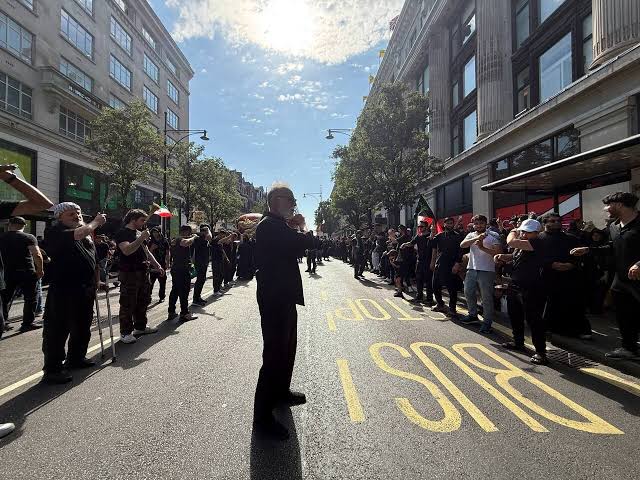


Alwaght- As the days of Ashura mourning arrive, followers of Imam Hussein's school of freedom around the world have held various ceremonies honoring the grandson of Prophet Muhammad and the martyrs of Karbala. Reports indicate this year's Ashura commemorations took place in over 50 countries, and beyond Shiite-majority nations like Iran, Iraq, Lebanon, and Bahrain, they drew large crowds of Muslims and Shiites across Europe, the Americas, Asia, and Africa. In places like Lebanon, Iraq, and Iran, recent wars and political developments lent the rituals a particularly charged and poignant tone.
This report takes a look at Ashura traditions across the world:
Labbaik Ya Hussein chants at heart of London
Thousands of Shiites and devotees of the Ahl al-Bayt took to the streets of central London on Friday, marching in mourning processions, hoisting the banners of Imam Hussein, and chanting "Labbaik ya Hussein(we are at your service Imam Hussein)" and "Hayhat minna al-dhilla (never to humiliation)", the rallying cry of Karbala, right in the heart of the British capital.
Gathering at Marble Arch before noon, mourners from diverse nationalities prayed the noon and afternoon prayers together, listened to the recitation of the martyrdom saga, then set off on one of London's longest and most visually striking Ashura routes. Dressed in black and carrying standards emblazoned with the names of Imam Hussein, his brother Abbas, and the other Karbala martyrs, they processed from Oxford Street toward Downing Street.
The resonant elegiac chants, lamentations, and cries of Labbaik ya Hussein and Hayhat minna al-dhilla echoed through central London, a majestic display of the bond between the lovers of the family of Prophet Muhammad and the eternal epic of Karbala, nd drew the eyes of countless residents and tourists along the way.
Eulogists and preachers recited in Persian, Arabic, Urdu, and English along the route, as mourners beat their chests in grief, commemorating Imam Hussein and his faithful companions who gave their lives to defend Islam, justice, and human dignity.
With Iranians, Iraqis, Afghans, Pakistanis, Lebanese, Bahrainis, and Shiites of other nationalities taking part, the ceremony took on a truly transnational character. Despite language and cultural differences, participants gathered under the banner of Imam Hussein, proving that the message of Ashura, centuries on, has crossed every geographical border and continues to unite the hearts of freedom-seekers around the world.
Roar of the Shiites in Pakistan
After Iran and Iraq, Pakistan is home to the largest Ashura gatherings. Shiites in Pakistan and devotees of the Ahl al-Bayt mourned the tragic martyrdom of Imam Hussein and his loyal companions on Friday, Ashura, in cities across the country. In these spiritual gatherings, they also renewed their pledge of allegiance to the late leader of Iran's Islamic Revolution, Grand Ayatollah Seyyed Ali Khamenei.
Reports suggested that from north to south, including Islamabad, Rawalpindi, Peshawar, Lahore, Karachi, Quetta, Skardu, Gilgit, and Hyderabad, millions of mourners turned out in force, forming processions of eulogy reciters, chest-beating congregations, and chains-wielding groups.
In Quetta, Parachinar, Skardu, Lahore, and Karachi, the faithful carried portraits of Iran's late Supreme Leader, Ayatollah Seyyed Ali Khamenei, and his successor Ayatollah Seyyed Mojtaba Khamenei, renewing their oath of loyalty to the current leader of the Islamic Revolution. In the capital Islamabad and neighboring Rawalpindi, lovers of Imam Hussein also held Ashura rituals with tearful eyes and chants of Labbaik ya Hussein. Security was exceptionally tight across Pakistan for this year's Ashura observances.
Iraq
Iraq is the epicenter of Ashura commemorations. Millions of pilgrims from across the globe converged on the city of Karbala, holding mourning rituals, chest-beating, chain-flogging, and the traditional "Tuweirij run" at the shrines of Imam Hussein and his faithful brother Abbas.
On Ashura day, Karbala hosted millions of pilgrims from Iran, Lebanon, Pakistan, India, the Persian Gulf states, Europe, and Africa. The standout observances included the mourning ceremonies at the two holy shrines, the mass-participation Tuweirij run, a centuries-old tradition where mourners dash through the streets toward the shrines, the massive distribution of votive food by thousands of roadside service stations, or "mawakib", and a heavy security presence to protect the mourners. This year, the Iraqi government deployed tens of thousands of security personnel and deployed surveillance drones to keep the events safe.
Lebanon
In Lebanon, Ashura ranks as one of the biggest religious events on the Shiite calendar. Tens of thousands turned out in Beirut, the southern suburbs of Dahieh, and southern cities like Nabatieh for this year's observances. This year, the mourning atmosphere was deeply colored by the ongoing Israeli aggression, with many ceremonies dedicated to the memory of those martyred in defense of Lebanon’s territory against Israeli occupation. In some areas, however, tazieh, or mourning rituals and dramatic reenactments commemorating the martyrdom of Imam Hussein were canceled over security concerns.
India
India boasts some of the oldest Shiite mourning traditions in the world, with ceremonies held this year in Lucknow, Hyderabad, Srinagar, and Mumbai. In Kashmir, the Ashura procession, once restricted for years, has made a strong comeback in recent times, now drawing massive crowds once again. Meanwhile, in Lucknow, the tazieh rituals and mourning processions carry on a centuries-old legacy, with roots stretching back hundreds of years.
Afghanistan
In such cities as Kabul, Herat, Mazar-i-Sharif, and Bamiyan, Shiites held their Ashura mourning ceremonies. The Taliban authorities imposed special security measures in certain areas to ensure the observances proceeded without incident or sectarian friction.
Bahrain
In Manama and across Bahrain's Shiite-majority villages, Hussainiyahs and city streets hosted mourning ceremonies, recitations of the martyrdom narrative, and chest-beating processions. Ashura ranks as one of the most significant religious events of the year in Bahrain, which stands as a major hub for Persian Gulf Shiite mourning traditions. Hussainiyahs in the capital and surrounding villages were packed with Shiites and lovers of Ahl al-Bayt, with chest-beating and chain-flogging processions winding through the streets, while lectures stretched late into the night. Given Bahrain's Shiite majority and the political sensitivities that often accompany the observance, the government rolls out special security measures annually.
Azerbaijan
In Baku, Ganja, and other Shiite-populated areas across Azerbaijan, mosques and Hussainiyahs held mourning ceremonies, drawing thousands to the commemorations. The observances took shape primarily as eulogy recitations, chest-beating rituals, and congregational prayers, with a distinctly solemn and disciplined atmosphere prevailing throughout.
Turkey
In Turkey, Shiite and Alawite communities marked Ashura with their own distinct traditions across cities including Istanbul, Ankara, and Iğdır, though the observances of Twelver Ja'fari Shiites and Alawites took noticeably different forms. The main ceremonies were held in Istanbul, Ankara, Iğdır, and Kars. Among the Alawites, Ashura is observed primarily through fasting, prayer, and spiritual rituals, different from the Twelver Shiite rituals.
Syria
In the capital city of Damascus, particularly around shrine of Sayyedah Zainab, the sister of Imam Hussein, Ashura ceremonies drew thousands of pilgrims from both inside Syria and abroad. The observances featured recitations of the martyrdom narrative, chest-beating rituals, religious lectures, and the hosting of pilgrims with food and refreshments, all under stringent security measures.
Persian Gulf Arab states
In Kuwait, Oman, Qatar, and parts of Saudi Arabia, particularly the eastern provinces of Qatif and Al-Aqsa, Ashura mourning ceremonies were held in Hussainiyahs and mosques.
Saudi Arabia: In Shiite-majority areas like Qatif and Al-Ahsa, Hussainiyahs hosted the observances, with thousands in attendance.
Kuwait: Hussainiyahs across Kuwait opened their doors from the first night of Muharram through Ashura, drawing tens of thousands of mourners. Prominent religious scholars led the ceremonies and delivered lectures.
Qatar: The Shiite community in Qatar held eulogy recitations, speeches, and mourning rituals in Hussainiyahs and Islamic centers.
Oman: In cities with significant Shiite populations, the ceremonies proceeded calmly and without major restrictions, maintaining a low-key and orderly character throughout.
Shiite communities in various Western countries
In several Western countries, Ashura ceremonies were held in Hussainiyahs and, in some cases, through street processions. Commemorations took place in Canada (Toronto, Montreal, Vancouver), the US (New York, Washington, Detroit, Houston), Germany, France, Sweden, and Australia. Observances largely featured processions, recitations of the martyrdom narrative, religious lectures, and blood drives inspired by the message of Ashura.
Germany: In Berlin, Hamburg, Cologne, and Frankfurt, Islamic centers hosted mourning ceremonies, blood donation campaigns, and cultural programs.
France: In Paris and Lyon, Shiite communities held mourning rituals and lectures, with some events also drawing non-Shiite Muslims.
Sweden: In Stockholm, Gothenburg, and Malmö, religious delegations marked Ashura with processions and mourning assemblies.
Canada: In Toronto, Montreal, and Vancouver, ceremonies drew thousands. Many Islamic centers also organized blood drives, charity collections, and outreach programs introducing Ashura's message to non-Muslims.
The US: In New York, Washington, Detroit, and Houston, mourning rituals, processions, and cultural conferences brought together Muslims of various nationalities.
African countries
In Nigeria, Tanzania, Kenya, and Senegal, Shiite communities also held mourning ceremonies and commemorative assemblies.
Nigeria: Led by local religious bodies, Shiites in cities such as Zaria, Kano, and Abuja observed Ashura with the usual rituals. Given the history of tensions between the government and Nigeria's Islamic Movement, security was notably heavy across the affected areas.
Tanzania, Kenya, and Senegal: Shiite communities, largely comprising South Asian expatriates and Lebanese-descended residents, gathered at Islamic centers and Hussainiyahs for eulogy recitations, chest-beating, and the ritual feeding of mourners.