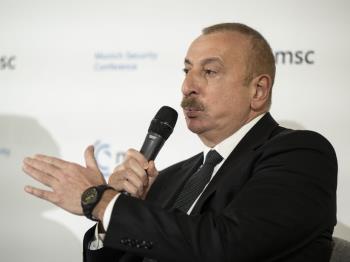




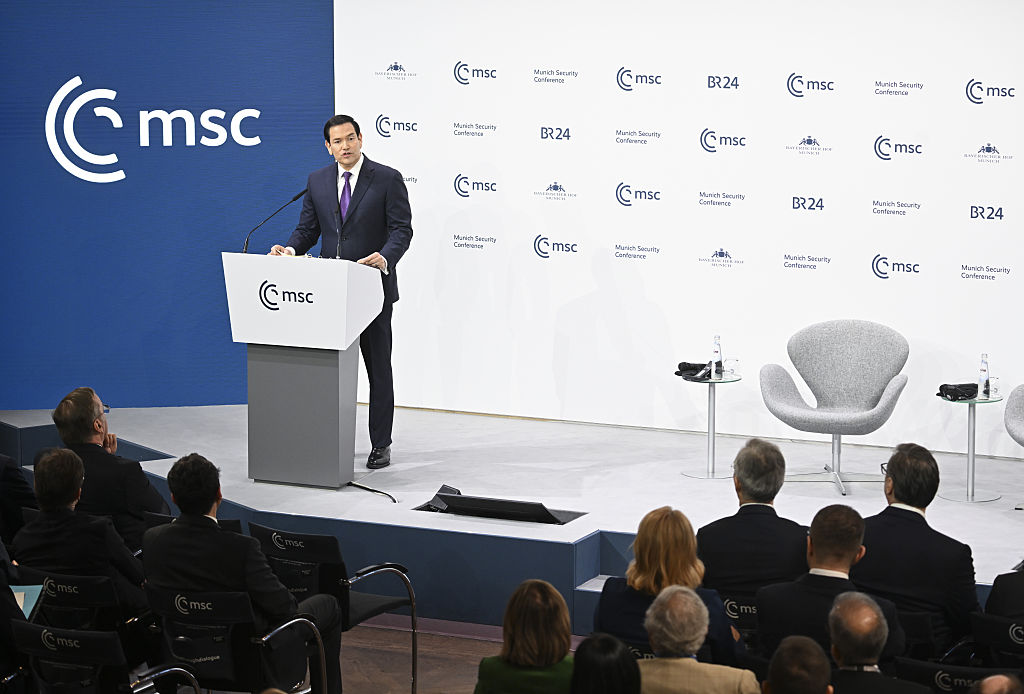


Alwaght- Munich Security Conference is being held in a climate totally different from past years. For decades, especially after end of the WWIIand and the Cold War, this event marked the strategic cohesion of the West and was recognized as the most important platform of the world security dialogue, one where trans-Atlantic elites discuss major global security issues. But today, this conference is being held as the world order is undergoing deep transformation and the post-WWII world order is facing fundamental challenges. The order where the American and European interests took a center stage now shows clear signs of erosion and decline.
Moving past unipolar order to new poles
The post-1945 international order was built on the foundation of Western political, economic, and military superiority. Its institutions, rules, and security mechanisms were a direct reflection of this balance of power. In the aftermath of the Soviet downfall, the narrative took hold that the West was not just a military victor, but an ideological one, positioning its model as the template for global governance.
Today, that reality has shifted. Power is being redistributed. The pivot of influence toward the East and the emergence of new geopolitical polarizations are now unmistakable. Robust economic growth, rapid technological leaps, and sweeping military modernization across Asia and the wider "Global South" are fundamentally challenging the West's traditional dominance. Powers like China and Russia have not only gained greater economic and military heft but are also actively contesting the Western liberal order on an ideological and discursive level.
This shifting balance is more than a simple transfer of hard power; it signals a fundamental change in the paradigms of development, security, and governance. A growing number of nations across Asia, Africa, and Latin America are rejecting foreign policy and security dictates from the West. Instead, they are diversifying their strategic partnerships or adopting a more pronounced balancing act to reduce their unilateral dependence on Western powers.
The West is no longer the sole civilizational axis or the primary driver of the world's major economic, political, cultural, and geopolitical trends. The transition toward a new, multipolar international system is no longer a distant forecast; it is a present-day reality.
Absence of emerging powers and MSC legitimacy crisis
One of the most telling signs of this tectonic shift is the conspicuous absence or diminished role of emerging powers at forums like the Munich Security Conference. These nations, which view the current global architecture as fundamentally discriminatory and unjust, interpret the West's interventionist policies as a form of "civilizational warfare", a posture they blame for widespread destabilization across West Asia, Africa, and even parts of East Asia and Latin America.
In this new climate, the credibility of the Munich Security Conference as a Western-centric platform for prescribing solutions to global challenges is increasingly under fire. Critics argue that such events reflect the strategic preferences of a narrow club of nations rather than representing any genuine global consensus. In a world growing more pluralistic by the day, exclusive mechanisms are facing a crisis of legitimacy.
Gaza war and Western moral crisis
Gaza crisis over the past two years has marked the most important turning point in the decline of the Western moral discourse. A war started with a massive Israeli campaign targeting the civilians in Gaza continued with political and military support of the Western governments, something questioning the long-held Western claims about support to the human rights, democracy, and equality of humans. For the critics of the Western order, what has happened in Gaza has not been just a regional crisis, but a sign of inefficiency of the Western-centric security mechanism.
For many Global South countries, this crisis signaled duality of the Western standards, where human rights principles are not seen as universal values but as political pressure tools. The outcome is undermining of legitimacy of the Western-dominated institutions, including the Munich Security Conference. When a security architecture that claims to defend a rules-based order falls silent or complicit in the face of widespread violations of those very rules, its credibility is naturally the first casualty.
Trans-Atlantic gap and fall of Western convergence
Another critical factor eroding the Munich conference's standing is the growing rift within the Western bloc itself, particularly between the US and Europe. Trade disputes, technological rivalries, clashes over defense spending, and fundamentally different approaches to dealing with China and Russia have all weakened trans-Atlantic cohesion.
Europe, rebuilt after World War II under the protective umbrella of American security, now faces a profound question regarding its own strategic autonomy. Yet the experience of the Ukraine war has exposed the continent's continued dependence on Washington in key military and security domains. When the crisis hit, European nations struggled to formulate an effective strategy to manage the conflict or contain Russia without relying on the United States. Numerous European-led initiatives either fizzled out or were effectively overshadowed by Washington's policies. This divergence escalated into a direct clash of interests over Greenland, where Europe and the US found themselves openly aligned as opposing poles on a geopolitical issue.
The Munich Security Conference, once a proud emblem of European diplomatic and security clout, now resembles an event with diminishing weight in the actual power equations. It has become an event seemingly paralyzed, unable even to find a way to bridge the very Atlantic divides it was partly created to manage.
Strategic pivot to the East and global rebalancing
In such conditions, many countries are redefining their geopolitical priorities. Broader interaction with China and Russia, membership or cooperation with such blocs as BRICS or regional Asian organizations, and the push to break free from dollar dominance and Western-dominated financial institutions all make up part of the power transition to the East.
These developments do not mean full West omission from the world equations, but show that the West is no longer the sole determining factor in the world dynamics. Instead of obeying Munich Security Conference's agendas, countries seek diversity and creating balance, a strategy enabling further maneuvering and independence of decision-making.
Musnic Security Conference on the verge of a historical redefinition
Should the Munich Security Conference cling to its imperialistic and Western-centric worldview, it will only accelerate its own marginalization. The world is in the midst of a transition toward a multipolar order, one where legitimacy is no longer derived from a narrow consensus among Western powers, but from genuine and equitable participation by all global actors.
Finally, Munich event is the icon of an era when the West viewed itself as the unrivaled architect of global security. But that era is over. The world has entered a different age where shifting power balances, alternative discourses, and emerging players are redrawing the map of global influence. If the conference fails to adapt to this new reality, it may soon find itself remembered not as a forum for global decision-making, but as a vestige of a bygone order.