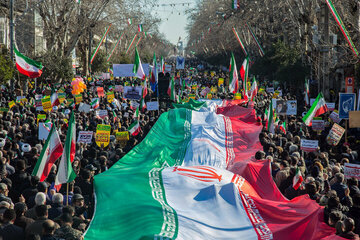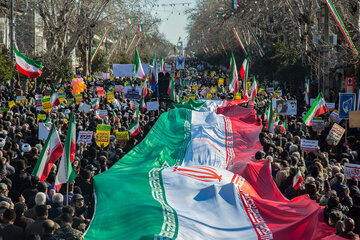






Alwaght- It has been 47 years since the Islamic Revolution took place in Iran, and this year, too, the Iranians are celebrating the anniversary, known as 22 Bahman, as the symbol of resistance and firmness. A revolution that toppled a submissive pro-Western monarchy with aspirations for justice, independence, and freedom has managed to weather the pressures and challenges of years and establish its position in various areas.
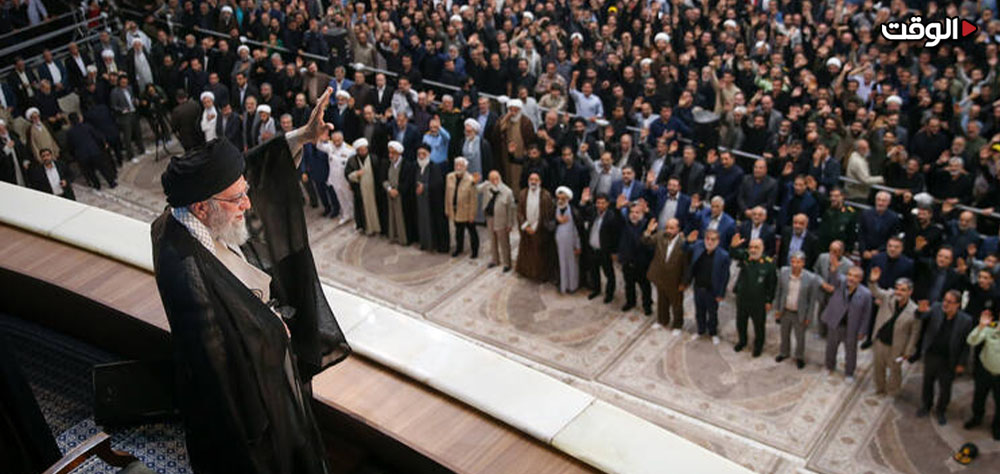
The massive turnout at this year’s anniversary rallies for the Islamic Revolution’s victory is not merely a commemoration of the past, it stands as a powerful display of national unity and the Islamic Republic’s deterrence capabilities.
The celebrations also highlight Iran’s scientific, technological and strategic advances, underscoring how adherence to revolutionary principles has steered the country past threats and shaped it into an independent and influential power. Forty-seven years on, the Islamic Republic sends a clear message to the world that it remains determined and driven on its chosen path.
Scientific achievements of 47 years
Despite persistent efforts by Western powers to obstruct Iran’s scientific advancement and prevent the country from making independent decisions outside the emerging global order, Iran has managed to secure notable rankings by relying on the talents of its scientific elites and pursuing targeted science-development policies. The country has consolidated its presence in key fields such as medicine, aerospace, nanotechnology, and nuclear energy. These achievements reflect national resolve and scientific capacity, demonstrating that even under restrictive conditions and unjust sanctions, Iran’s path of scientific progress has not been halted.
Today, Iran ranks fourth globally in nanotechnology and has achieved self-sufficiency in pharmaceutical production, manufacturing more than 97 percent of the medicines it needs domestically. The country is also among the world’s top ten producers of biotechnology drugs, including anti-cancer medications and growth hormone treatments.
In the nuclear energy sector, mastery of uranium enrichment technology has enabled Iran to generate electricity and support medical and agricultural applications. The Bushehr Nuclear Power Plant, operating at full capacity, stands as a symbol of the country’s energy independence.
In the space arena, Iran has joined a small club of nations capable of launching satellites using entirely indigenous technology. On the defense front, the Islamic Republic has solidified its deterrence power through the production of ballistic and hypersonic missiles as well as advanced drones—capabilities that have even compelled its adversaries to acknowledge Iran’s strength.
The combination of defensive power, scientific advancement, and national cohesion has reinforced the image of the Islamic Republic as a resilient and forward-looking state. This comes at a time when Iran was subjected to the harshest unjust sanctions and international restrictions, yet still managed, through strong will and relentless effort, to achieve these remarkable scientific milestones.
Rather than impeding progress, these constraints became a catalyst for reaching new heights in modern science and technology. These successes stand as clear evidence of self-reliance, innovation, and the capabilities of Iran’s scientific elite, who paved the country’s path forward even under the most difficult circumstances.
Principle of countering the imperialism
Since the first days of its establishment, the Islamic Republic picked an identity marked by countering imperialism and defending the oppressed. These principles are not periodical slogans but the fundamental pillars of an ideological and political order in the depth of the Islamic Revolution, which since the outset made its stance on oppression and imperialism clear, asserting that it would not stay silent to the excesses of big imperialist powers.
In this framework, the US, as the primary symbol of the global hegemonic system, has consistently stood in direct opposition to the Islamic Republic of Iran. Washington’s interventionist policies, comprehensive political and economic pressures, and sanctions have not only failed to break the national will of Iran but have instead strengthened it. During these years Iran has tried to warn nations about the overbearing nature of the US, demonstrating to them that security and interests are contingent on breaking dependence on Washington.
Alongside confronting Western imperialism, the Islamic Republic, from its very inception, adopted a clear and unequivocal stance against the Israeli occupation of Palestine. Defending the Palestinian cause and opposing the occupation of Islamic lands became one of the most distinctive features of Iran’s foreign policy and identity. This worldview stemmed from profound revolutionary and religious convictions, a belief that standing against oppression is not a political choice, but a moral and human duty. This transparent position has solidified the Islamic Republic’s role as a voice demanding justice in West Asia and has demonstrated that revolutionary principles remain the foundation of the country’s foreign policy.
Insistence on principles practically
Adherence to these fundamental principles has only deepened and solidified over time, despite mounting pressures and threats. For nearly five decades, Iran has paid a heavy price for its steadfast commitment to its stated ideals, yet it has never retreated from its declared path. This resilience culminated in its 47th year, when Iran faced a direct confrontation with its adversaries.
The 12-day war imposed on Iran by the US and the Israeli regime marked a turning point in this conflict. This direct engagement served as a critical test of the Islamic Republic’s sincerity in adhering to its ideals. The outcome was the failure of its enemies to achieve their objectives or impose their will upon the Iranian nation, a defeat that demonstrated the principles of the Islamic Revolution are not mere rhetoric, but manifest in action.
What further underscores this historical experience is the Islamic Republic’s readiness to pay the price and make sacrifices on the path to realizing its ideals. This steadfastness finds its meaning in popular support; a people who, at critical junctures, have repeatedly demonstrated their continued allegiance to the ideals of the Islamic Revolution. Thus, in practice, the Islamic Republic has proven that confronting imperialism and domination is not a transient slogan, but the enduring identity and conscious choice of a nation.
Despite the West and the Israeli regime’s persistent efforts to weaken the Islamic Republic and break the popular support for it, all such schemes have failed in practice. The enemies’ strategy has consistently focused on maximum pressure, psychological operations, media warfare, and the incitement of internal discontent, hoping to weaken the bond between the people and the government and pave the way for their ambitious goals. However, realities on the ground have shown, once again, that these calculations are far removed from a deep understanding of Iranian society.
While segments of the populace harbor criticisms regarding economic challenges and certain inefficiencies, Iran’s historical experience has shown that internal criticism never equates to alignment with an external enemy. The nation’s steadfastness against the warmongering of the US and the Israeli regime is clear evidence of a political and social maturity that has prevented adversaries from achieving their goals of undermining the country’s security and independence.
Public backing for the Islamic Republic has not been confined to the 12-day war. In the wake of the recent unrest, shaped and steered by the US and Israeli intelligence services, the public once again demonstrated its decisive role. The massive turnout of diverse social groups in the January 12 rallies amounted to a renewed pledge of allegiance to the ideals of the Islamic Revolution, sending an unmistakable message to the country’s adversaries.
This show of popular support not only foiled plans designed to destabilize the country and bring about the collapse of the Islamic system; it also underscored that public trust and solidarity remain the Islamic Republic’s core asset. Recent events have once again confirmed that whenever Iran’s independence and national existence come under threat, the Iranian people stand alongside the Islamic system and refuse to allow their country’s fate to be decided in foreign think tanks.
In general, over the past 47 years, Iran, by holding firm to the principles and ideals of the Revolution, has steadily strengthened its deterrence across political, defense, economic, and regional arenas. This strategic stability has reduced the country’s vulnerability and elevated its role in regional and global equations to that of an active, decisive actor, one where threats are converted into strategic opportunities and rivals’ decisions are shaped by the realities of Iran’s deterrent power.